
This is an ongoing series of blog posts based on papers originally written for my church’s elder class. Our subject for this entry is the doctrine of election.
The doctrine of election is one of the most controversial subjects often discussed within Christian theology. The concept of predestination, that God has chosen His people who will be saved not just in the course of their lives or because of their actions, but from before creation itself, has drawn many objections, including from Christians. It is a subject that requires patience and pastoral care alongside a devotion to Scripture’s inerrancy and sufficiency. It also requires a great deal of humility, which often seems to be alien to the debates this issue raises.
The doctrine of election is a necessary consequence to the concept of God’s grace, God’s decision to deal in patience and love with those who demonstrably have rebelled against him. Throughout Scripture, God has chosen to bless individuals or peoples for reasons that are entirely His own. We see this pattern develop virtually from the beginning in Scripture, and every step of the way, the Bible makes it clear that the purpose is to bring salvation into the world. God’s end, as stated repeatedly, is to save vast numbers beyond what the receiver of the promise can comprehend. For example, Abraham receives this promise from God that from him and Sarah would come a great people, and that through them all the families of the earth would be blessed. We are given no reason that God has chosen Abraham, simply that He chose him to be the one through whom He would enact the great plan of salvation for creation.
God’s choice throughout
In Deuteronomy 7 Moses speaks on this to the people, saying in verses 7-8, “The Lord had his heart set on you and chose you, not because you were more numerous than all peoples, for you were the fewest of all peoples. But because the Lord loved you and kept the oath he swore to your ancestors, he brought you out with a strong hand and redeemed you from the place of slavery, from the power of Pharaoh king of Egypt.” God’s love for them was entirely of His own choice and will, and not because of any special thing Israel had done. He had elected them to be His, and through them, to bring His people of all nations to Him in Christ.
Just as Moses was calling the Israelites to humble gratitude and obedience for God’s choosing them purely out of His love and grace, so Paul calls believers to the same attitude:
Blessed is the God and Father of our Lord Jesus Christ, who has blessed us with every spiritual blessing in the heavens in Christ. For he chose us in him, before the foundation of the world, to be holy and blameless in love before him. He predestined us to be adopted as sons through Jesus Christ for himself, according to the good pleasure of his will, to the praise of his glorious grace that he lavished on us in the Beloved One. – Ephesians 1:3-6
Let’s focus on the aspect of election that tends to be most controversial: that those who are saved, are saved entirely because God chooses to save them, and not by any will or work of their own. When we discussed regeneration I mentioned the vision of the valley of dry bones from Ezekiel 37. Those dry bones had absolutely no good thing to recommend them to God, yet He gave them renewed flesh and life. Likewise, believers are not saved because they have made themselves holy, or because there’s something special about us. God has chosen His people for His own reasons, many of which we are not going to know, other than what Paul just said – because He wants to, and for the sake of His own glory.
Going against the grain
This idea is frustrating for several reasons, but two of the biggest are that it rubs up against our human desire to be in charge of our own destiny, and because it raises difficult questions about what it means that God has elected some to salvation and not others. Those who oppose this idea accuse those of us who hold the reformed position of believing that humans are “robots,” with no real choice, since God has preprogrammed everything and just set us down to run.
To the latter objection, there is both a strong philosophical as well as biblical response. Are we robots? Well, we certainly have predilections, we have aspects of ourselves that are bent towards particular desires. We also have the unfortunate habit of managing to do evil even when we mean to do what is good. Why does this matter? Because it points to the fact that no matter how hard we try, we’re not going to scrub ourselves clean. We won’t make ourselves holy before God. Even Israel’s religious practices pointed to this – making oneself clean, let alone holy, was difficult, and becoming unclean was remarkably easy. So we need to be cleansed by Someone who cannot be dirtied.
Our own desires war against it, and that’s why regeneration is tied in so deeply with election. It’s difficult to discuss one without confronting the other. Regeneration cannot be the result of our own choice. Without God transforming our hearts, even a choice to believe is tinged with selfishness that will ultimately
The King of all commands us to what is good
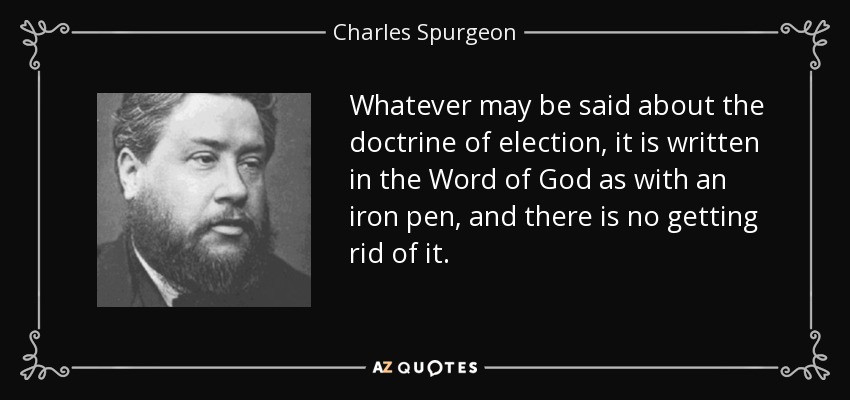
The objection is also raised alongside this that God would therefore be the author of sin. In the span of this time I scarcely have time to address all of the objections and challenges. I would simply say in the context of what we have discussed so far that we have affirmed and seen from Scripture that God is sovereign. Indeed, if He is God at all, He must be. Scripture says that not a hair is uncounted on our heads, and a sparrow doesn’t fall without His knowledge. Yet Scripture also affirms that rebellion against God exists in this world, in the hearts of humanity. So the most simple way I can respond to these objections would be the words of Charles Spurgeon:
I believe the doctrine of election, because I am quite sure that if God had not chosen me I should never have chosen him; and I am sure he chose me before I was born, or else he never would have chosen me afterwards; and he must have elected me for reasons unknown to me, for I never could find any reason in myself why he should have looked upon me with special love.
As to the question of why God would elect only some people to salvation, in the words of RC Sproul in Chosen By God, “I don’t know. I have no idea why God saves some but not all….One thing I do know, if it pleases God to save some and not all, there is nothing wrong with that. God is not under obligation to save anybody.” We must not presume upon God’s grace, but fall down at His feet in praise of it.
At rest in His work
Now that we have spelled out this doctrine and some of its foundations (for I don’t pretend that this is an exhaustive explanation, and there are full books out there on this subject alone), the question is: what do we do with this? For even though salvation is God’s work, it’s a work He has set us to. The means of salvation is the preaching of the gospel of Jesus Christ, and we are called to see it carried throughout the world. We love our neighbors by sharing the good news that they can be reconciled with their Creator, the One who made them in His image and who sent His Son out of love for His creation. But if it’s true that it’s those whom He has chosen since before time began that will be saved, what should that do to our efforts to minister the gospel?
There are many objections and questions that revolve around this, but they all revolve around a central misunderstanding of the nature of God’s grace, and the necessity of the work of God in our hearts to be able to receive it. Grace is freely given by God, for His reasons and glory. It’s not a thing that is earned. It is an act of love for His creation that led God to His work of salvation. Yet over and over again humanity has spit in God’s face – the Old Testament has God’s own people even rejecting Him repeatedly and running back to idol worship. God would set them free, and lead them back through hardship into His promises – and then the cycle would repeat. The drama of the fall of man in Genesis 3 would be reenacted in greater cycles.
That’s why the coming of Jesus was needed. Man has deepened his capacity for evil. Paul’s words in Romans 1 as to the state of humanity’s hearts are full of descriptors of our capacity for sin but the phrase “inventors of evil” from verse 30 rings out in my mind as unique: not only are we rebelling against the good God is trying to guide us to by the fact of our selfish, sin-loving natures, we are actually trying to find new and greater ways to commit evil acts, to indulge ourselves in depths that are further and further from God. This is what we as humans do, when left to our own devices.
God’s grace is our only hope
The only hope we have is election. It is only by God’s gracious love that any of humanity can be saved, because it’s not our ability to reason that will bring us to God. Humanity is capable of excellent acts of logic, philosophy, and creativity, yet there is a missing ingredient that keeps us from having the wherewithal within ourselves to come to God. And that missing ingredient is a recognition of our need for God, and the humility that comes from that recognition that brings us to Him.
Twice in Proverbs and once in Psalms the phrase “The fear of the Lord is the beginning of wisdom” appears. That’s where the path of Jesus begins. That’s what the work of the Holy Spirit in calling God’s elect to Himself plants: bringing us to that fear of God. Not simply being scared, because I think it’s clear that there is an instinctual fear and dread of the true biblical idea of God’s great and overwhelming glory and power planted deep in our very selves that’s evident from things like the art we produce.
But the fear of the Lord is also more than simply another word for respect. When we come face to face with God’s holiness, that light shines brightly upon our own sin. We see a picture of that in Isaiah 6, in the picture of his utter undoing when he finds himself in the presence of the Lord in the temple – and we see the picture of God’s work to impart holiness when the angel brings the coal to his lips to cleanse him.
I know that is my own story as well, of having that deep transformative encounter with the reality of God’s holiness that utterly shattered my own self-image of “being okay.” No longer was I someone who was fine because I held certain opinions in my brain. My sin, my hypocrisy, my lack of love for God and for others – all of it was brought to the surface and exposed to me in a moment that broke me.
Yet God did not leave me there. The ministry of the gospel to my heart was also a picture of God’s great love, and it made me want to share it with others. It’s what has driven me to create this podcast and to work to share writings like this with others. It’s what leads me to have difficult conversations – a desire to see others know their Creator as well, to stop running after things that bring only death and to have real life.
And this is why salvation is a fully Trinitarian work of God. God calls His people to Himself, the Son takes the weight of their sin upon Himself as He serves as the perfect atoning sacrifice for them, and the Spirit works to transform their hearts to a new life that glorifies God, that truly and fully trusts in the work of Christ not just for their sins but to make the path they tread in life and through death into eternity.
But here is where we must grab hold of the most critical reaction our hearts should have to this doctrine: we must seize upon it on our knees, in full humility. The reaction to the idea of God’s free choice in grace of His people must bring us to a wide-eyed recognition of the fact that we did nothing to earn our place. It is entirely because of His love, His glory, His patience that any of us are saved at all. That humility must shine through in how we love and worship our Lord. It must be evident in how we love one another, how we love our neighbors, how we serve our cities and pursue the hearts of the lost of this world.
There is absolutely no room for arrogance or presumption. We are entitled to nothing and yet we receive everything, by the graces of the King. Therefore we must be generous with everything, because He has been infinitely generous with us. We must especially be generous in prayer, because it is through prayer that we see God’s hand working in our world. The question “Why am I saved and my neighbor isn’t?” ought to answered in our hearts with the only real response possible: “I can’t know the answer, but I can ask my Father to save him.”
How have you wrestled with this doctrine? What questions are still unanswered? How have you seen the truth of God’s grace worked out in your life? Leave a comment below or email us!


2 Replies to “What We Believe – Election”