
This is an ongoing series of blog posts based on papers originally written for my church’s elder class. This week’s topic is sanctification in the life of Christians.
Christian preaching works heavily through the concepts of justification and sanctification, and for good reason. We have seen many instances throughout the history of the church where the two concepts have been muddled and confused, and it has led to a great deal of strife. To this day we still struggle with discerning the difference, either by mixing sanctification into justification in a way that requires perfection in the now in order to be or remain justified, or by emphasizing justification so heavily that sanctification becomes an afterthought. The former leads to pharisaism and legalism, and the latter leads to antinomianism and a lack of care for holiness.
From God’s eternal perspective, we are clean and holy in Christ, a finished work that glorifies Him. But to us as we walk through each day of life, the sanctification of the Spirit can involve hardship, frustration, conviction, and even suffering. One passage that captures this duality is Romans 8:28-30:
We know that all things work together for the good of those who love God, who are called according to his purpose. For those he foreknew he also predestined to be conformed to the image of his Son, so that he would be the firstborn among many brothers and sisters. And those he predestined, he also called; and those he called, he also justified; and those he justified, he also glorified.
The battle within ourselves
Yet in our daily experiences we don’t often feel this. Indeed, we often experience a deep sense of frustration as we live out the words of Paul in the preceding chapter, that “when I want to do what is good, evil is present with me.” As we strive forward towards the cross, our flesh continues to fail us. We find our motivations called into question, our hearts heavy, as we mourn the effects of sin even as we also rejoice in our circumstances and struggles. But this is not something we ought to lose hope over. There is, after all, excellent reason that chapter 7 is followed by chapter 8, and the joyful, life-giving truth that “there is now no condemnation for those who are in Christ Jesus.”
Paul’s words in chapter 6 spell out the reality of sanctification for the Christian, and indeed I think it is how we can see the Lord working in our lives. It isn’t in moments of ease and contemplation that our love for God is most cultivated, but the times we experience and resist temptation. Our happiest times are made all the sweeter when we reflect on what we endure to get there, and especially in knowing that God walks through them with us. Our Lord is not distant, after all, because He too suffered with us. He too endured temptation, and in His power we have the right to reject our sinful desires and weaknesses. We can reject the condemnation of the enemy and embrace the truth that we are dead to sin, and alive in Christ.
We endure many things in this life, which serves to grind away at the hardness of heart, fear, doubt, and all the other things that point to the ways that we don’t trust God’s love and promises. For the person who loves God, when we consider all the experiences life may hold, God is promising that each and every one of them will work for our good. This idea is awe-inspiring, but also becomes incredibly vexatious to many when we consider what that might include. Disease? Financial hardship? Horrible abuse? The evils of war? Loss of a child? God’s Word is clear: yes, even these, though to walk with someone through this notion who has experienced suffering on this scale demands a great deal of empathy, patience, and pastoral care.
Purpose in all things – even the hard things
Sanctification in the Christian life is a significant part of our answer to the question of suffering and evil in this world. Why does God allow them to persist? We do not know His wisdom at its greatest height, nor would we be foolish enough to attempt to, but we do know suffering works its way through our lives so that we may be transformed, degree by degree, into the image of Christ. It is through the lens of Christ – His life, His work, His suffering and death, and His resurrected life – that we are able to endure suffering.
When we experience hardship, grinding away at our lives and comforts, we are able to most fully embrace the truth of Paul’s words in 2 Corinthians 3:17 and 18. We have a freedom by the Spirit that this world cannot take away, and as we behold the truth and love of Christ we further embrace this freedom to endure this dark world. We have freedom in Christ to live knowing that He is better, He is stronger, He is more loving and gracious and providing than this world will ever be. We have freedom to endure evil knowing that He will bring justice to bear upon it in perfect time. We have freedom to be generous ourselves because He is infinitely generous towards us with what we need. And we have the freedom to give up everything, even our lives, because He stands with us, and receives us in glory as His own.
Sanctification’s role in what Paul describes in Romans 8:28-30 can be summed up in the phrase, “God ordains the ends and the means.” I can look at my life and at experiences like struggling to make ends meet, at relationships beginning and ending, or times of literal pain. I can think of moments that the Holy Spirit has lifted an idol from my hands in love, one I had been holding back for so long, and in the aftermath of that I found not loss, but true gain. I found my step lighter and my heart more free. This is why I say that sanctification is dying to ourselves, and finding freedom in Christ. We die to desires that weigh us down and find that the weight was only oppression on our souls. And when passages like Paul’s come to mind in those times when we are wrestling with our flesh, we can take heart in them.
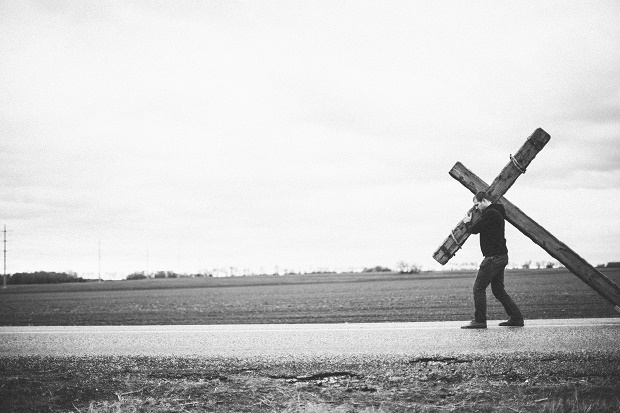
Whatever the pain and suffering, whatever the idol being wrenched from our grasps, whatever evil the world is throwing at us, all of it serves ultimately for our good in Christ. All of it demonstrates that no matter what the world says we need or what we should value, no matter what our flesh longs for, no matter what evil another may perpetrate against us, God’s love is greater. His good plan will come to full fruition in perfect time. And so, we strive to endure it by the strength granted us as we follow behind Christ, our crosses on our shoulders, knowing that death is not the end. J. Todd Billings writes in his book Rejoicing in Lament:
As the Heidelberg Catechism states, “Even as I already now experience in my heart the beginning of eternal joy, so after this life I will have perfect blessedness such as no eye has seen, no ear has heard, no human heart has ever imagined: a blessedness in which to praise God forever.” The continuity between now and then is none other than our incorporation into the life of Christ.
So we walk through sanctification each day, whatever that may look like, and we encourage one another in it in patient love, rejoicing in the Lord always. We do the work before us because it is what leads us to the day that we will truly, as Paul writes in Romans 8:29, “be conformed to the image of Christ.” To us now, that day seems far in the distance, but God sees it clearly before Him, a people made holy and perfect and honored for enduring to the end.
Hope in all seasons, patience in affliction
Our story is one of sanctification. All the victories and failures of live, the pleasures and discomforts, they are not purposeless. They are meant to pry our hands free from this life – not in a nihilistic way, but in a manner that points to eternity.
I think of all the encouragements I could give to others in this, it is that we are not meant to walk through this alone. We are never truly alone of course, in that the Holy Spirit is with us and within us, giving us strength and guidance through all things. But we should seek out those who encourage our spiritual strengthening, who aid in stirring our affections for Christ and who in turn we can serve and encourage in their own walks and strivings. Be with believers who will listen, and who will aid in prayerful and practical ways – and be ready to serve.
The Bible is full of warnings against hardening our hearts, and encouragement that to endure is to see the fruit of Christ grow in our lives. I want to encourage those of you who may be struggling in any way that you are not alone in that. If nothing else, Jake and I are here to provide prayer and encouragement. The Lord knows your needs, and is with you through it all. After all this comes not a statement, but a question: how can we pray for you?
 Coronation Radio